The Neanderthal Flute
A Prehistoric Instrument That Changed Our Understanding of Neanderthals
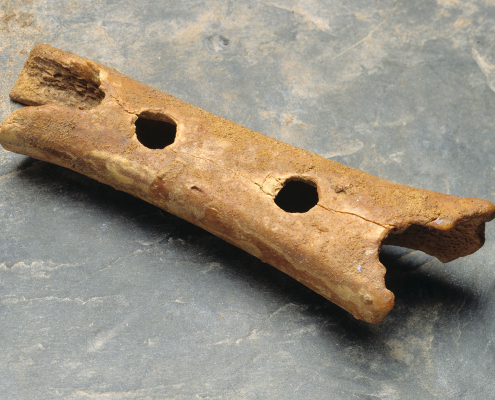
The Neanderthal flute from Divje Babe is considered the world’s oldest known musical instrument in the world and one of the most significant archaeological finds of global importance. It was discovered in Divje Babe I Cave, located on a steep slope above the Idrijca River valley in the Idrija–Cerkno hills of western Slovenia. The discovery confirmed that Neanderthals were already creating music more than 60,000 years ago, demonstrating advanced creativity, symbolic expression, and a rich cultural world. Because of this exceptional discovery, Divje Babe is often referred to as the cradle of world music.
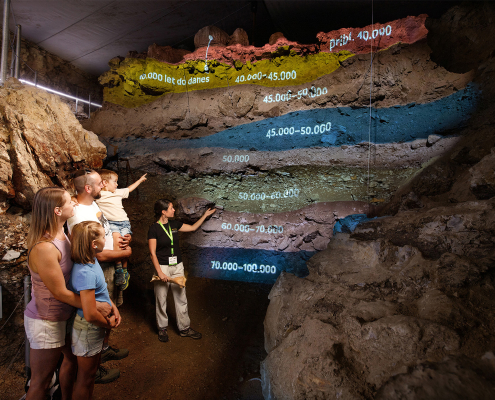
The Neanderthal flute was made from the left femur of a young cave bear. Using stone and bone tools, the maker created four holes and a sharpened mouthpiece edge. The carefully positioned holes clearly indicate that the instrument was intentionally designed for producing sound. The flute was discovered near the remains of a fireplace dated between 50,000 and 60,000 years old. Its shape was also carefully considered. The natural curve of the bone, its size, and the precision of the workmanship suggest ergonomic adaptation for a right-handed player.
The arrangement of the holes enabled researchers to create playable reconstructions of the instrument. Among the first to study its acoustic properties was musicologist Dr. Drago Kunej, who demonstrated through replicas that the instrument could produce sound and support complex playing techniques. Further musical experiments confirmed a surprisingly wide tonal range and the ability to perform varied and technically demanding music.
The Divje Babe flute is at least 10,000 years older than the oldest previously known flutes made by the first anatomically modern humans in Europe.
Because of its characteristics and sound capabilities, the discovery fundamentally changed earlier perceptions of Neanderthals as beings without artistic or symbolic expression.
Reconstructions of the instrument revealed rich sound possibilities and a tonal range of approximately 3.5 octaves.
Its capabilities suggest that the flute was not used only for signalling or hunting, but also have played an important ceremonial or symbolic role. Today, the Neanderthal flute from Divje Babe remains an important contribution to the understanding of Neanderthals as culturally and creatively developed humans while also confirming the deep roots of music in human history.
Academic musician Ljuben Dimkaroski was among the first to systematically explore playing the reconstructed flute; he named the instrument “Tidldibab,” after the initials of those who conceived it as a musical instrument and after the archaeological park—that is, in addition to Dimkaroski, also after archaeologist Ivan Turk and the Divje Babe cave. His work is continued today by academic musician and multi-instrumentalist Boštjan Gombač.
The original Neanderthal flute is preserved in the National Museum of Slovenia and remains one of the key symbols of prehistoric world heritage.
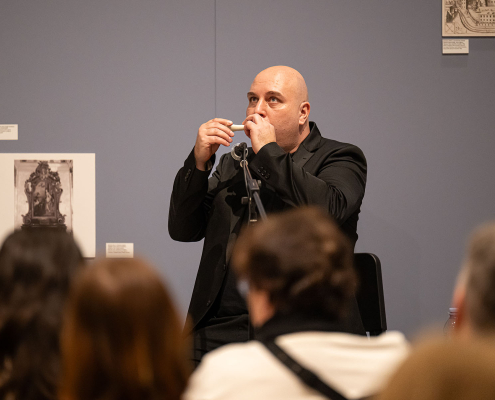
Boštjan Gombač performing on a reconstruction of the Neanderthal flute at Divje Babe.
Performance on a reconstruction of the Neanderthal flute by Boštjan Gombač.